
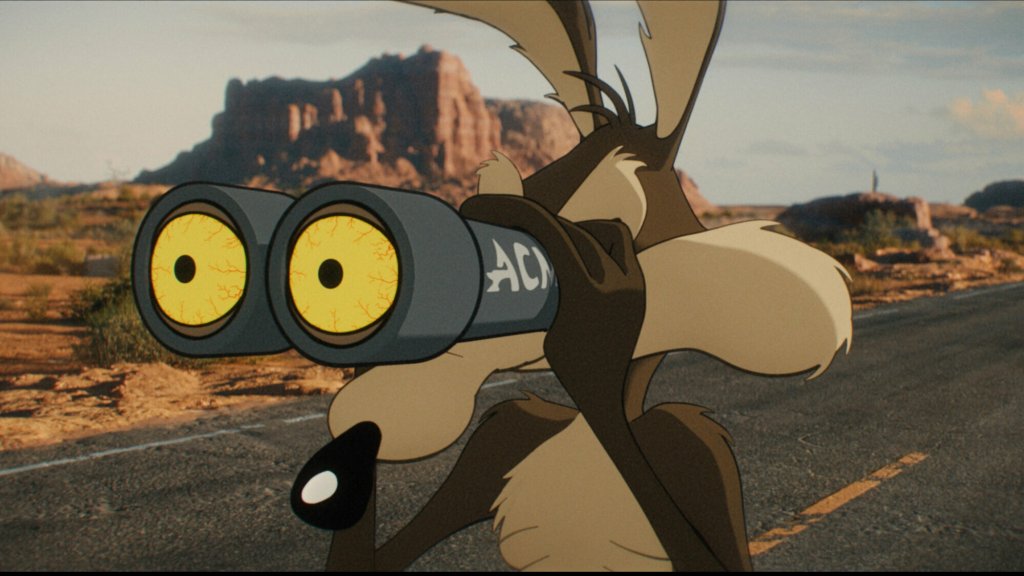
Coyote vs. Acme (2026)
[103 minutes. PG. Director: Dave Green]
I’ve always had a certain empathy toward Wile E. Coyote, dating back to my days huddled in front of the TV watching reruns of Looney Tunes on Nickelodeon. I think some of this was the simplicity of the premise and setting: like Spy vs. Spy, the writers concocted one imaginative scenario after another with two characters who never share dialog, set against a sun-baked desert backdrop. But I also hated that smug Roadrunner, and wanted to see the day when Wile E. emerged victorious in his longstanding – and unrewarding – quest.
“Acme” became synonymous with overly elaborate – yet consistently ineffective – contraptions that, in a way, came to mirror our Modern American sensibilities toward cheap junk that conveniences us in the short-term, while populating the landfills with slow decay long-term.
What seems like a throwaway novelty concept – Wile E. hires a billboard lawyer (Will Forte) to take his case against Acme – proves itself a contender for the best movie of 2026 (no kidding). An assured blend of animation and live action, Coyote vs. Acme retains its zany cartoon roots (gags come on so fast and furious that they can probably only be properly deconstructed with your remote’s slow-motion button), contains some huge laughs (stemming from a lot of absurd and unpredictable humor), but is also clever in its takedown of the heartlessness of corporate America and the Billionaire Class.
There are nods to All the President’s Men and Ned Beatty’s epic monologue in Network, which makes sense, as, at the end of the day, this is as character-based as any of those iconic 1970s studio films that were able to push their messaging through a mainstream outlet without dumbing down their themes. At the end of the day, it speaks to the symbiotic relationship between predator and prey, consumer and consumed, built on a mutual need tangled in an unsolvable existential paradox. It was enough to make me shed a tear or two. (4 out of 5 stars)
Onslaught (2026)
[92 minutes. R. Director: Adam Wingard]
It wasn’t until Onslaught was over that I came to an answer to my over-arcing question: what the hell is Rebecca Hall – an actress in the Julianne Moore/Cate Blanchett leagues – doing in this thing? Then some amorphous pop-culture jelly festering in the lower recesses of my brain remembered, vaguely, that Hall was in some of those big-budget Godzilla movies over the last couple years, one – or more – of which was directed by Adam Wingard.
Maybe Hall enjoyed her experience on those sets enough to pop in for an extended cameo in Onslaught. Maybe Wingard called in some sort of favor. In any case, Hall – who delivers her best even when the project doesn’t deserve it – is a welcome bit of class in this otherwise crass and forgettable effort (in which the once-reputable A24 starts to look a lot like Screen Gems).
Stop me if you’ve heard this one before: Hall and her husband (Dan Stevens in Monty Burns old-man makeup) have come up with a prototype for a super-soldier that will help usher in a new Reich (the opening credits flippantly reference Nazi experiments in World War II for edgelord Cool Points), but need to give their trio of hulking freaks a test run. The soldiers’ capabilities are quickly explained but ultimately irrelevant, since the script (by frequent Wingard collaborator and overall font of mediocrity Simon Barret) doesn’t have much interest in following the rules.
The film tries – and fails – to create a new Snake Plissken-styled badass in the form of Adria Arjona’s ex-solider/single mother whittling away her existence in a trailer park out in the desert. Arjona herself is more than capable, but – like Hall – can only do so much with this middle-of-the-road genre concoction cobbled together from superior parts. I’d say John Carpenter is rolling in his grave at this mish-mosh, but Carpenter is very much alive…and probably paying videogames at home…while being oblivious to Onslaught’s existence. (2 out of 5 stars)
Teenage Sex and Death at Camp Miasma (2026)
[112 minutes. R. Director: Jane Schoenbrun]
Schoenbrun comes on strong – way too strong, if we’re being honest – spewing hot buzzwords and contemporary talking points relative to indie cinema and gender identity, to the point of being off-putting. But as I Saw the TV Glow and now Teenage Sex and Death at Camp Miasma attests to, this sense of the awkward and the insecure and the eye-rolling in its hapless young protagonist (a 29-year old film director tasked with the “rebooting” of the titular Camp Miasma slasher series) is very much by design.
Schoenbrun is acknowledging the paradox of the continued necessity of the cultural conversation surrounding the slasher film (from its misanthropy, misogyny, and – yes – transphobia) whilst being just as susceptible to the excessive charms of seeing a uniquely masked killer tearing through a cadre of horny teens with sharp implements.
The slasher here – nicknamed “Little Death” – is in on the joke of its existence, both as a metaphor and as a literal visual vortex caught in the banality of a ceiling-vent helmet. Reclusive icon Billy (Gillian Anderson), who becomes the lynchpin for the Camp Miasma reboot, has been to all the places – psychologically, emotionally, sexually – our young, repressed protagonist wishes she could go. She has also acclimated to the bizarre metaphysical fantasy-world in which she exists.
As with Glow, Schoenbrun is interested in individual perception – how we watch and process art – which makes the gooey references to Cronenberg’s Videodrome seem not only thematically appropriate, but cool as hell. I wonder where my own perception will take me on subsequent viewings. (4 out of 5 stars)


Leave a Reply