
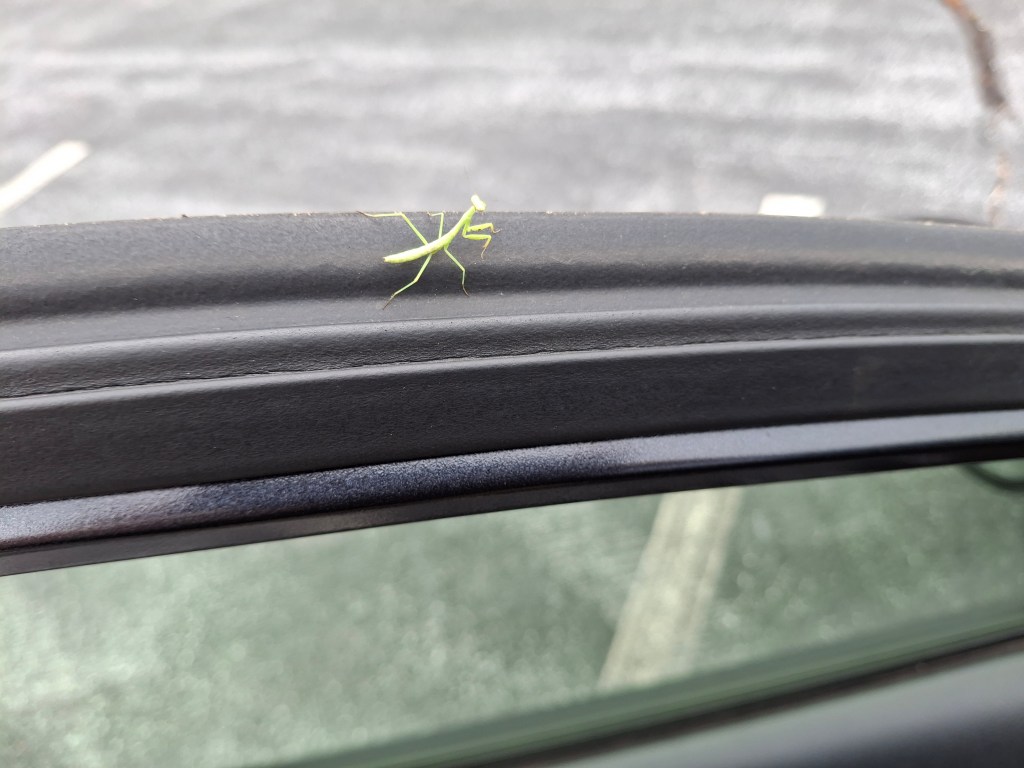
Or: The Lesson of the Praying Mantis.
As I backed out of my driveway to go to an opening-day matinee of Evil Dead Burn, I noticed something out the corner of my eye.
At first, I thought a bit of greenery had blown in through my cracked driver’s-side window and become enmeshed in a tiny spiderweb. (Seeing small spiders in my car is a more regular occurrence than I wish to admit, given my arachnophobia.)
But, as I allowed my eyes to focus, I noticed – much to my surprise – that it wasn’t a leaf on the inside window-rim, but a quarter-sized Praying Mantis.
So, for the 15-20 minutes it took to travel from my house to the theater, I embarked on an unspoken – yet mutually agreed-upon – covenant with the Mountain Dew-colored insect:
I will leave you in peace. When I arrive at my destination, I’ll take you to safety.
Which, when I pulled into a space in the enormous – and mostly empty – parking lot, is just what I did.
At first, it was reluctant to crawl onto the piece of scrap paper I’d pulled from my glove box, but it eventually remembered the covenant and climbed aboard, remaining stoic as I walked it over to the treeline bordering the theater.
It seemed like the right thing to do, and I felt better for having done it.
I pondered how rough 2026 has been – not just for me, but for many, many others – and decided that helping this largely passive creature that was just minding its own business was a proper step toward pushing against the bad karma that permeates nearly every single aspect of existence these days.
****
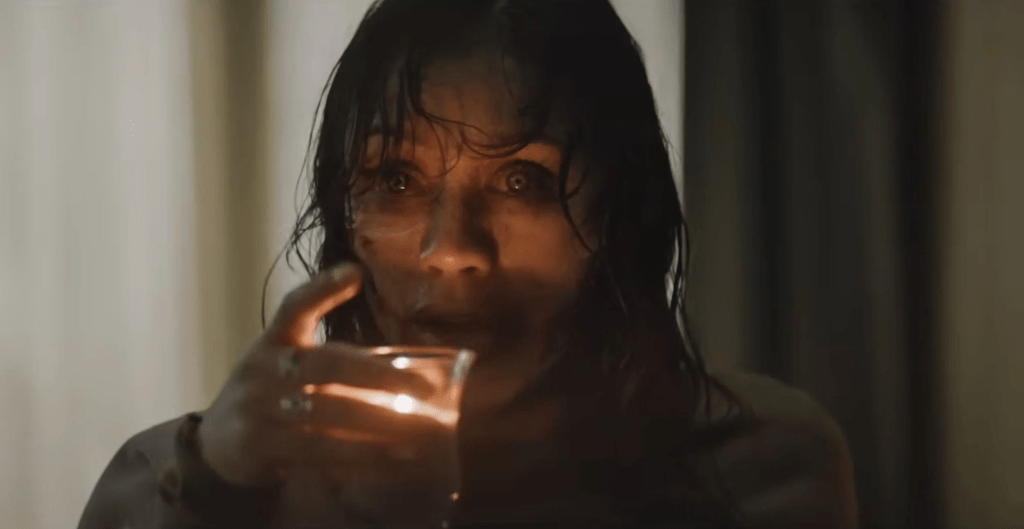
I preface my review of Evil Dead Burn thus because the film itself is a total contrast to the act of helping that Praying Mantis. It’s a mean, ugly, nasty, and relentless assault that, in many ways, encapsulates a year that’s driven many to the precipice of anger, depression, and desperation.
But there’s a serenity to the Praying Mantis – I wondered if it was frightened as it crawled along the window-rim during the drive, or when I attempted to scoop it up and move it to safety. Such stoicism is, by its very nature, hard to read.
Evil Dead Burn is so downbeat that it’s hard to call its action “cathartic” – we’re far from the Raimi/Campbell Three Stooges-styled slapstick and on a decidedly grimmer path. With its bright coloring and calm manner, the Praying Mantis stands as a beacon in dark times, as if to say: perhaps not all is lost.
****
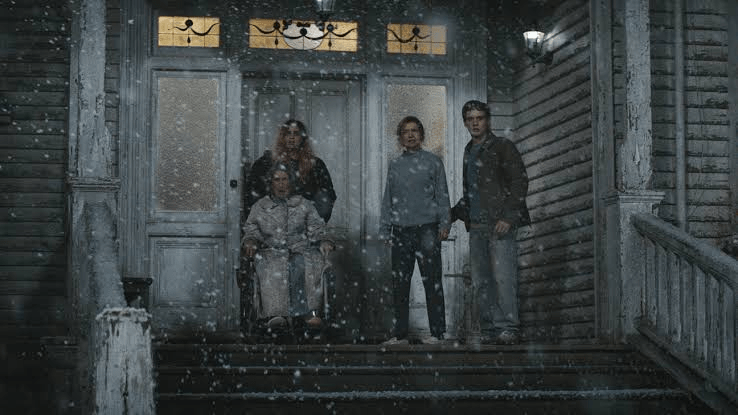
One of the first scenes in Evil Dead Burn takes place in a club, with asses jiggling and people shouting over loud music. There’s an immediate sense of disorientation as we piece together that a birthday is being celebrated: Joseph (Anton Yelchin doppelganger Hunter Doohan) and his partner, Thya (Luciane Buchanan) are being treated by Will (George Pullar) and Alice (Souheila Yacoub), but the character relationships aren’t clear.
Flash forward to Will getting into a fiery auto wreck (caused by a mysterious female Deadite) and the depressing funeral service at a local crematorium, where mother Susan (Isabelle Huppert doppelganger Tandi Wright), father Edgar (Erroll Shand), grandmother Polly (Maude Davey), Joseph, Thya, and Alice congregate to mourn the loss.
It becomes clear that Will was Joseph’s brother, a successful alpha with a mean streak. Alice was Will’s unfortunate wife. But it takes more time and character interaction to piece this all together.
At first, I considered this poor screenwriting…but it’s actually quite purposeful. This is a family that doesn’t communicate, and certainly doesn’t share its emotions. In fact, they seem mired in a deeply-ingrained negativity secondary to Will’s passing. Susan and Edgar favor the deceased son, and hold wannabe writer Joseph in contempt. Susan is bitter; Edgar is stoic; and Polly has long lost her mind. Therefore, the younger generation is left to carry the cumulative weight of the familial burden.
The irony of there being no instruction manual for dealing with death and the grief and anger that follows is complemented by the bizarre “opportunity” the Book of the Dead presents in resurrecting the deceased for a chance to make ghastly amends.
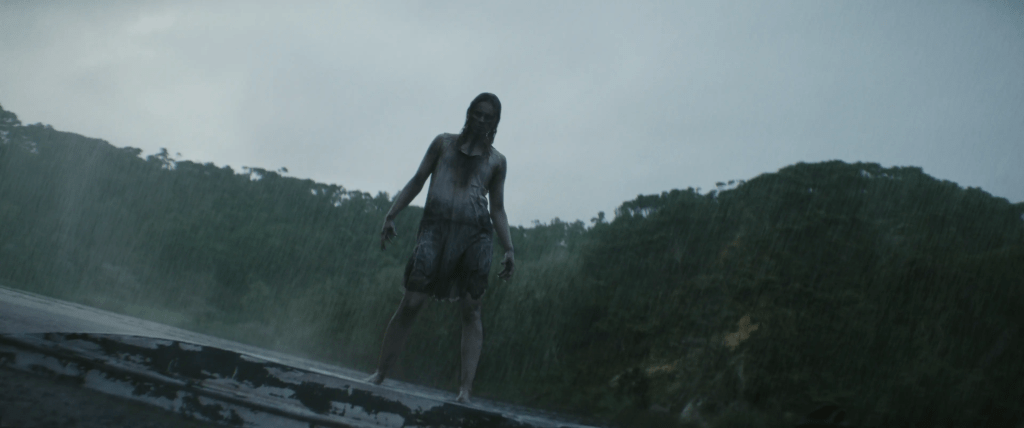
There are asides in Evil Dead Burn that appear to be angling for laughs, but I’m not sure if co-writers Sebastien Vanicek (who also directs) and Florent Bernard are looking for humor more than additional cringe content to supplement the emotional and violent extremes on display. While obligatory, the appearance of Bruce Campbell’s smug mug seems out of place here.
But this is unquestionably an Evil Dead film, as evidenced in the boundary-pushing carnage, the frenetic camera work, and the Deadites themselves. It is indicative of the maximalist, “more is more” state of the reboot series begun with Fede Alvarez’s 2013 film through Lee Cronin’s Evil Dead Rise in 2023, down to the inclusion of a flawed female protagonist left to absorb the brunt of the physical damage yet still live to see another day.
Following the funeral, the family retreats to their decaying country estate, a festering sore where all bad memories are stored – with an already somber scene amplified by the supernatural Deadite menace infiltrating an already weakened, emotionally distant bloodline.
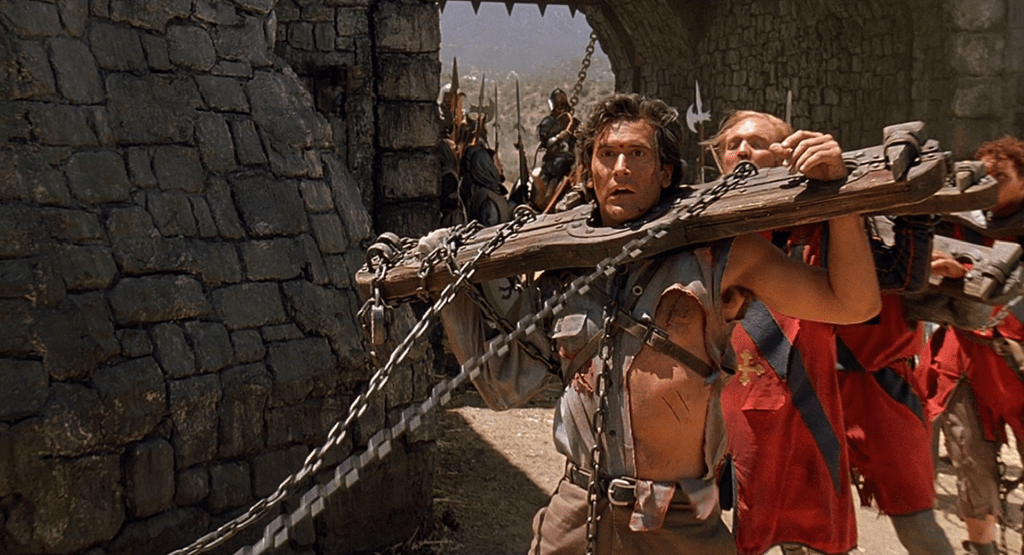
Evil Dead Burn reaches a pitch of existential horror that manifests in its unrelenting brutality: beaten relentlessly by Deadites, you eventually “die,” only to come back, doomed to a limbo of absorbing and inflicting pain. The yuks of Evil Dead 2 and Army of Darkness are but a distant memory. This is an evolution of the mythos and shoestring-budget techniques Raimi experimented with in his early career. To pursue the goofy shadow of those films in a slavish, nostalgia-baiting fashion would seem insincere, especially given the hellscape of the post-Covid era.
The performers are allowed levels of dramatic nuance, and the pacing takes its time in introducing the cast of characters before diving into the mayhem proper. There are even moments where Vanicek creates a duality between fear and tenderness that’s alternately touching (Susan’s encounter with newly-turned-Deadite Polly) and gross (Susan’s prolonged kiss with a horribly disfigured Edgar).
As a foreigner, Alice is rendered as an interloper among the all-American family – with their psychologically repressed sensibilities – and reinforces the desire to assign blame to an “outsider”…even in a scenario where the dead are coming back to life. When grief is the order of the day, the prioritization of a scapegoat becomes crucial for the family to distract from their own bottled-up emotions. That said, Alice’s own numbness and seeming ambivalence masks a volcanic rage that comes to a head when the Deadite possession begins claiming the family, one by one.
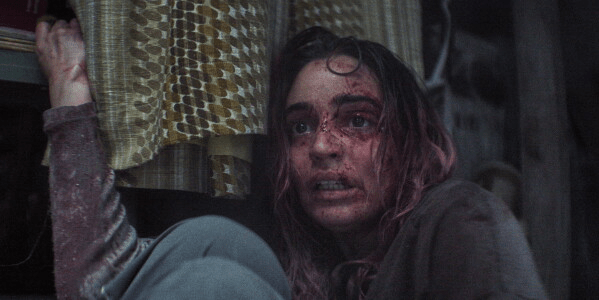
As in most Evil Dead films, the plot is but a pesky obligation in the interest of setting up a brutal carnival spookhouse riddled with battered bodies and flayed flesh. In Burn, the Deadites are awakened (the family are direct descendants of the scientist who discovered the Book of the Dead) and seeking possession of the alchemic dagger that can destroy them, but that mostly takes a backseat to interweaving the thematic and character beats with barnstorming violence.
On the subject of violence, the age-old question crossed my mind more than once: is the excess justified, or is it just gratuitous sadism? The film is tough to watch, but the gore isn’t glamorous – it’s cruel, cold, and unforgiving. Many of us have been feeling pummeled these last couple years, and this underlines the beat-down we’ve endured. Not all will want to subject themselves to this – nor should they – but this pushing of boundaries has been the hallmark of the Evil Dead series since its inception, and Burn has the advantage of being the most dramatically astute of the bunch.
4 out of 5 stars


Leave a Reply