

“The cruelty is the point.” – Dottie Elms
Adapated from the novel by Stephen King (written under his alias, Richard Bachman), The Long Walk is fueled by a simple plot that opens the gates for a narrative of unrelenting bleakness: in an unspecified future, America is dealing with the fallout of a war that his resulted in an unbridgeable gap between the Haves and Have-Nots.
To recapture the spirit of a downtrodden nation, those in power (the “who” and “why” doesn’t matter) concoct an annual contest wherein several dozen male participants compete in the titular event for the chance at an unimaginable cash payout and the granting of a “wish.” The catch? Your pace can’t fall below 3 miles per hour, you can’t leave the paved road, and there is no quarter given for bathroom breaks, cramps, or sleep. If you fail to abide by these rules, you get shot.
As Pantera put it: “Respect. Walk.”
I haven’t read the novel in years, so I’m not entirely sure which wrinkles in characterization and storytelling have been added by screenwriter JT Mollner (2024’s superlative sleeper, Strange Darling).
That said, the ending will create a schism for those who pledge allegiance to the printed page. It took me a night’s sleep to come to terms with Mollner and director Francis Lawrence’s adjustment, and…it feels right in its own way.
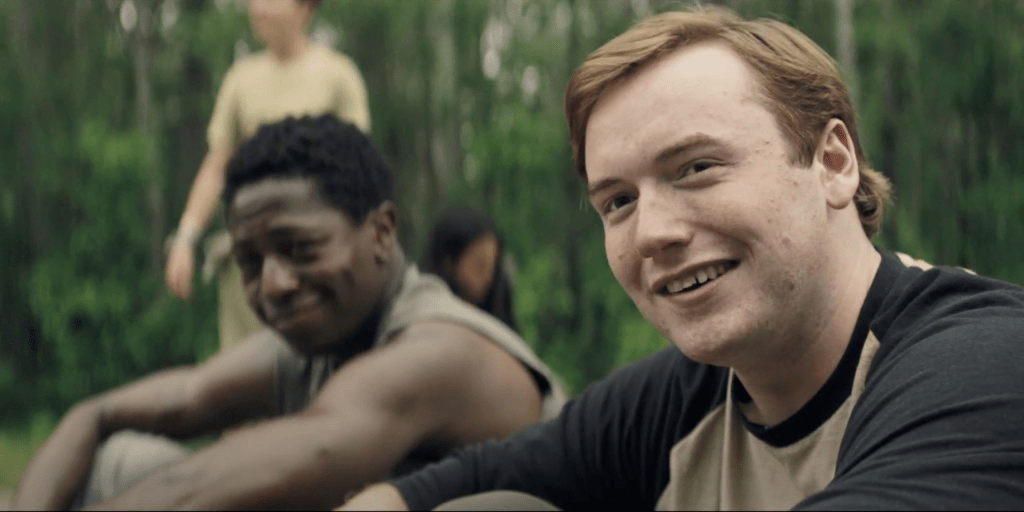
The novel saw initial publication in 1979 and its concept was analogous to the Vietnam War, pitting young men (late teens; early twenties) within a conflict where their chances of survival are largely attributable to luck and endurance. The “winner” only comes out ahead with a ghoulish, corpse-littered landscape behind him. How does anyone but a sociopath reconcile that?
Lawrence does little to make the proceedings overly “futuristic” in look and feel (this isn’t Paul Michael Glaser’s The Running Man, thank god), thus retaining a dystopian landscape lacking in any fancy gadgets or fantastical special effects. From a purely aesthetic perspective, this will aid in The Long Walk’s unfortunate timelessness.
The cutaways to roadside spectators, watching the contestants with weary eyes – or the images of horses running – paint a portrait of perverse Rockwellian serenity contrasted against ice-cold acts of violence that are nonetheless executed in accordance with their own set of “rules.”
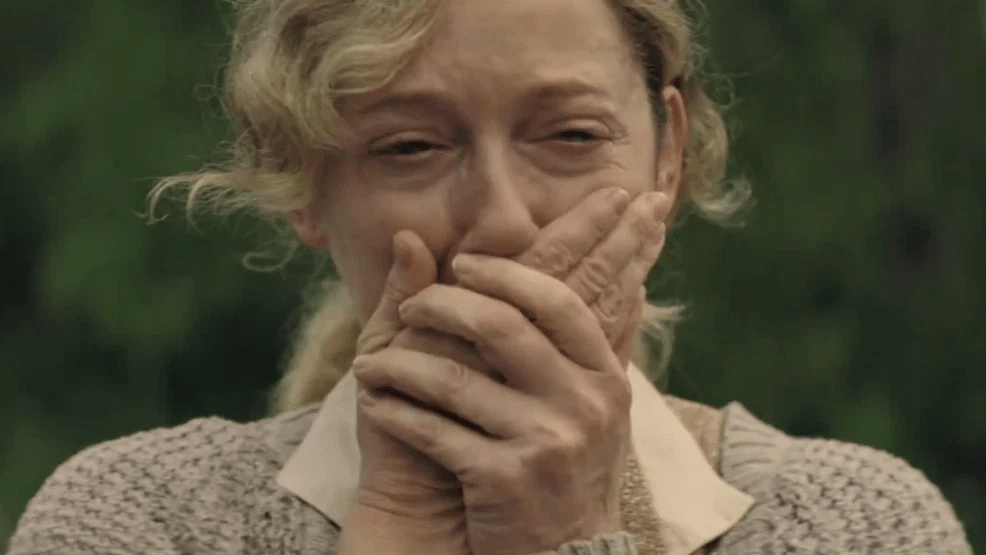
The boiled frog metaphor has been referenced a lot lately, and while the United States has not yet descended into another civil war – nor instituted a draft for said civil war – the country overall has acclimated to its own technological dystopia, where attention spans are shorter than ever, entertainment is disposable “content”, the national news is driven less by fact than opinion, investigative journalism is a cadaver-fart in the wind, and the normalizing of the deeply abnormal has become our New Normal.
The Long Walk exploits the very real hopelessness and helplessness that reduces these lottery-chosen young men to nonetheless “compete” for the aforementioned cash prize and wish as perhaps the only option in a repressive United States to shake free of their socioeconomic shackles and “make” something of themselves. It’s a dire, fucked-up scenario that many of the contestants/entrants/participants/victims paint as a once-in-a-lifetime opportunity, high probability of death be damned.
To encompass another metaphor: it’s the proverbial “carrot on a stick” that keeps the young men walking, even as bodies grow weary from exhaustion and sleep deprivation, and feet begin to blister and bleed from the sheer exertion of the task. Just how much can one push himself when the body and mind are screaming for a reprieve?
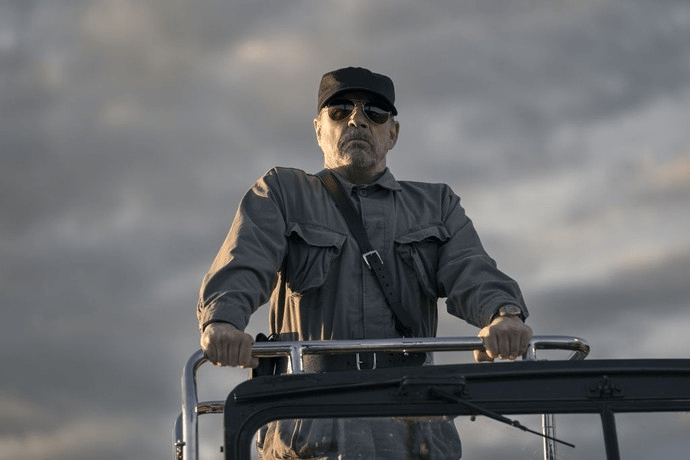
And while The Long Walk delivers visceral chills and shocks that are uncommon for a mainstream release, this is less the Lionsgate that rode a wave of financial success with The Hunger Games films (of which Lawrence directed all but one), and more a throwback to the days when the studio built its reputation by taking commercial risks with such gritty, nerve-jangling fare as Saw and The Devil’s Rejects.
The violence is tragic and profound in its horror. One gunshot in particular made me jump out of my seat.
Nearly every character is introduced and given a name and an accompanying trait that makes them unique among the contenders. While some may argue that everyone is reduced to a “walking” cliché as a result, Lawrence and Mollner ensure that a camaraderie is established, even as antagonism and bullying leads to carnage that’s blood-chilling in its callousness.
There are certain questions that bubble to the surface: why aren’t more of the walkers like Barkovich (Charlie Plummer), the antisocial creep who picks a fight with another contestant in the early going? Why aren’t the boys shoving each other off the road and into the grass – which results in instant death – thus thinning out the competition?

I like how the film doesn’t think to pursue these threads, as they would spiral down into the type of “body count” shenanigans that became the soulless stock and trade of nearly every ‘80s slasher sequel. That, and there’s an impatient easiness to such actions that would dilute the heaviness of the experience. It’s harder to write characters the viewer can empathize with than making everyone a collection of jerks whose deaths are to be cheered – in The Long Walk, it’s unconscionable enough that the unseen “viewers at home” are on the edges of their seats, less interested in the winner than the betting-pool mentality of who will get shot next.
Ergo, when a character states, “making friends on the Walk is a bad idea,” that’s what several characters wind up doing anyway. Ray Garraty (Cooper Hoffman), Pete McVries (David Jonsson – Alien: Romulus), and Hank Olson (Ben Wang) would appear to be our Final Boys from the moment the starter pistol goes off, but Lawrence maintains such a bleak tone (through the juxtaposition of serene rural and small-town landscapes) that an unshakeable feeling of unsettlement manifested in my guts for the 108-minute run time.
The young characters feel like the lived-in extensions of some of King’s best ensembles: the corpse-hunting teenagers of Stand by Me, and the Losers’ Club in It. The Long Walk becomes less about the outcome – though there is certainly suspense to be had in that department – than how the young men develop, grow, and – in some cases – give an actual shit about each other whilst attempting to overcome the grim paradox of the contest they’ve been drafted into.
4.5 out of 5 stars
 Jonny Numb
Leave a reply to William D Prystauk Cancel reply