

Quentin Tarantino and Damien Chazelle have an obvious affinity for the Tinseltown Dream Factory, but both are too smugly self-indulgent to present their love letters with anything resembling sincerity, insight, or – god forbid – innovation. The former’s Once Upon a Time in Hollywood spent nearly 3 hours spinning on aesthetics with barely a narrative through-line, while the latter looked to boundary-pushing shock value to cover Babylon‘s ultimate lack of subtext and creativity.
I’m kinda surprised to be saying it, but based on MaXXXine, Ti West might love Hollywood – and its timeless metaphorical power as a hungry beast that makes a buffet of fresh talent – more than Tarantino and Chazelle combined.
As the capstone to his X trilogy unspooled, I found my mind drifting not to the aforementioned ruminations on Hollywood, but stuff like Billy Wilder’s Sunset Boulevard – one of the more damning indictments of film-industry fickleness and dead-in-the-water careers. Or even Gus Van Sant’s suburban-absurdist meditation on a perky narcissist’s savage rise to fame in To Die For.
West’s lynchpin here is the titular character: Maxine Minx (Mia Goth), now residing in 1985 Los Angeles and making hay as a porn actress, aspires to a breakthrough in the mainstream. She’s first seen slaying an audition for a horror sequel, but when a mysterious videotape (chronicling her porn-and-violence deeds in X) and a snaggle-toothed private detective (Kevin Bacon) threaten the trajectory of her career, she embarks on a quest to silence anybody who might block her ascent to stardom.

Sure, the cliches are present and accounted for: coke is snorted; ‘80s fashions are indulged (with Goth made up like Liquid Sky’s Anne Carlisle at one point); sex workers (including a better-than-expected Halsey) talk with affectations right out of a 1940s screwball comedy; there’s even a black-gloved giallo killer stalking and slashing Maxine’s closest acquaintances. And, to that end, two persistent cops (Bobby Cannavale and Michelle Monaghan) lurk in the margins as the body count rises.
It’s no coincidence that MaXXXine has more in common with 1985’s Streetwalkin’ and the stylistic flourishes of Blood and Black Lace than any of the aesthetic touchpoints in Tarantino or Chazelle’s bloated, aching-for-prestige epics.
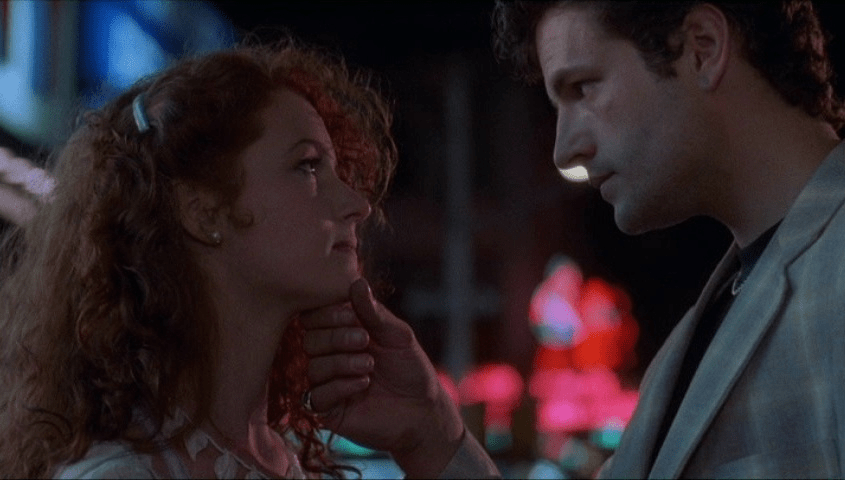
West’s incorporation of familiar period elements may seem disingenuous, but they’re really anything but: he takes what could have been lazy cliches and intertwines them in a story that, thematically, shows the wages of ambition and how the down payment for stardom usually involves bridges being burned – or people getting killed – along the way. He frequently defers to bulky TV monitors to convey details via evening news-reports, showing society’s passive reliance on “screens” long before the advent of the Smartphone.
Most tellingly, the filmmaker returns to some of the narrative tissue of X by incorporating outcry from the religious right (over the “bad influence” trifecta of pornography, violence, and horror). Many genre directors lean on exaggeration when it comes to religion (often defaulting to over-the-top depictions of flailing clerics), thus trivializing a potentially interesting thematic avenue. West’s prior horror experience proves advantageous here, especially with the credibility he brought to the unassuming slow burn of The House of the Devil. He commingles Maxine’s career trajectory, her past, and the Satanic-panic hype of the 1980s into a violent third act that underlines the contradictions inherent to any fundamentalist take on religion: the trick is to not become the thing you’re railing against.
As someone who’s shouldered criticism by his mere association with a genre many critics still dismiss outright, West finds a bit of himself – or any other Hollywood hopeful – in Maxine, whose ascent to stardom proves to be an uphill battle. But he is also eminently more qualified to examine the dirt, blood and other bodily fluids crusted beneath the fingernails of those who toil to be noticed within the vast crimson sea of cutthroat talents looking for their big break.
Meanwhile, Osgood Perkins has explored the triangulation of faith, isolation, and evil deeds in The Blackcoat’s Daughter. It’s familiar territory for the filmmaker, and while Old Scratch is a constant inspiration for great films (horror or otherwise), I can’t help but wonder if Perkins is reaching his threshold with such material.
I’m not sure why the Satanic aspect of Longlegs nagged me so. Perhaps it’s less a criticism and more a testament to how much the film knotted up my brain with its convoluted serial-killer mythology: ciphers (like the Zodiac!); symbolic dates; notions of demonic possession; and a main character who may or may not be blessed (or cursed) with a psychic link to the murderer. What does it all mean (if anything)?
Whereas Perkins’ previous films hinged on internal logic that worked so well because so much wasn’t explained through dialogue, the structure of a serial-killer thriller – even one that leans hard on the metaphysical – tends to default to scenes of characters speculating and explaining what’s happening. And while Longlegs may as well be a silent film compared to the more explicitly procedural likes of The Silence of the Lambs and Seven, its dialog tends to tangle itself up trying to explain things.
Lee Harker (Maika Monroe) is the green FBI agent haunted by a fateful meeting with the titular killer (Nicolas Cage) on her ninth birthday. Years pass, and Longlegs’ cycle seems to begin again. The dots are connected in a weirdly labyrinthine manner – one that can’t be fully deciphered upon a single viewing. Depending on how you feel about ambiguity, that may be a good or bad thing. (For the record, I like it.)

I guess that’s my way of saying: I soaked up Longlegs like a sponge.
And I like that feeling. It’s rare when mainstream horror exudes such a palpable grip on the viewer. It certainly speaks to the film’s overall jarring effect that the audience at my initial screening rarely cackled or snorted at what was happening on-screen. Even when Longlegs (the character) goes into histrionics, there’s something eerily off about it.
Conversely, Harker is one of Perkins’ signature Stoic Heroines. Monroe, often cast in roles that make excellent use of her hesitant, warbling delivery, finds herself manifesting a stillness that hides much behind an impenetrable façade. What does her character genuinely not know versus the suppressed memories of that fateful day in 1974? This detached quality may make Lee an off-putting protagonist for some viewers, but Monroe’s performance is a fascinatingly understated tour de force. She anchors the film when narrative logic becomes muddled, and is aided by an excellent supporting cast (including Blair Underwood and an unrecognizable Alicia Witt).
There are other strange things afoot. Things I’m not entirely sure hold greater meaning in the universe Perkins creates. Things that hinge on peripheral details I may have missed during my viewings (yes, I’ve seen it twice now). Things that may require a leap of cinematic faith to fully make sense of. Even when plumbing the depths of the well-trod serial-killer subgenre, Perkins remains a subtle craftsman, resistant to cheap jump-scares but fully cognizant of when and where to place a loud noise or a discordant musical cue. He reminds us that there is still an art to such things.
Not unlike Immaculate and The First Omen earlier this year, it’s interesting how MaXXXine and Longlegs go down similar faith-based rabbit-holes, and what happens when unyielding worship of an entity – whether good or evil – is taken to extremes. As 2024 proves to be yet another year where humanity must reckon with an existence verging on surreal parody, perhaps the brash, ruthless nature of Maxine Minx and the cold, barren landscapes of Longlegs are indicative of what waits on the horizon…and the steps we should take to preserve our own sanity (or whatever’s left of it), lest we become the things we hate.
That said, I will make one obscure comparison: I’m pretty sure Cage is channeling Tiny Tim’s performance in Blood Harvest.
Rating for MaXXXine and Longlegs: 4 out of 5 stars


Leave a Reply