

DISCLAIMER: I like Dakota Johnson (actress and daughter of one-time Hollywood Power Couple Don Johnson and Melanie Griffith). I sat through Fifty Shades of Grey, How to Be Single, and Cha Cha Real Smooth based solely on her involvement. And I believe her participation in 2018’s Suspiria is part of what makes it a superior remake.
While her choice of projects may not always be great, she is always interesting to watch. And her candor in interviews – especially with Madame Web flopping theatrically – makes her a refreshing presence in a sea of Hollywood fakery.
Said candor reminds me of her small role in 2012’s 21 Jump Street. In that film, Johnson played one of a group of teens tasked with going undercover to infiltrate criminal activity in local high schools.
Say what you will of the movie (I like it a lot), but Johnson is an effortless scene-stealer, juxtaposing beauty against exceedingly deadpan line delivery. Every time Channing Tatum and Jonah Hill enter the church/makeshift HQ, she administers one ego-blowing takedown after another.
This is how I conjured the notion of Dakota Johnson Syndrome. I’m not referring to her as a person (I’m sure she’s wonderful to know in private), but her character in 21 Jump Street (whose name is “Fugazy,” which would make this post even more confusing).
I feel like Johnson’s mannerisms and attitude in 21 Jump Street have come to unconsciously define the landscape of online interaction, and the world of film criticism in particular.
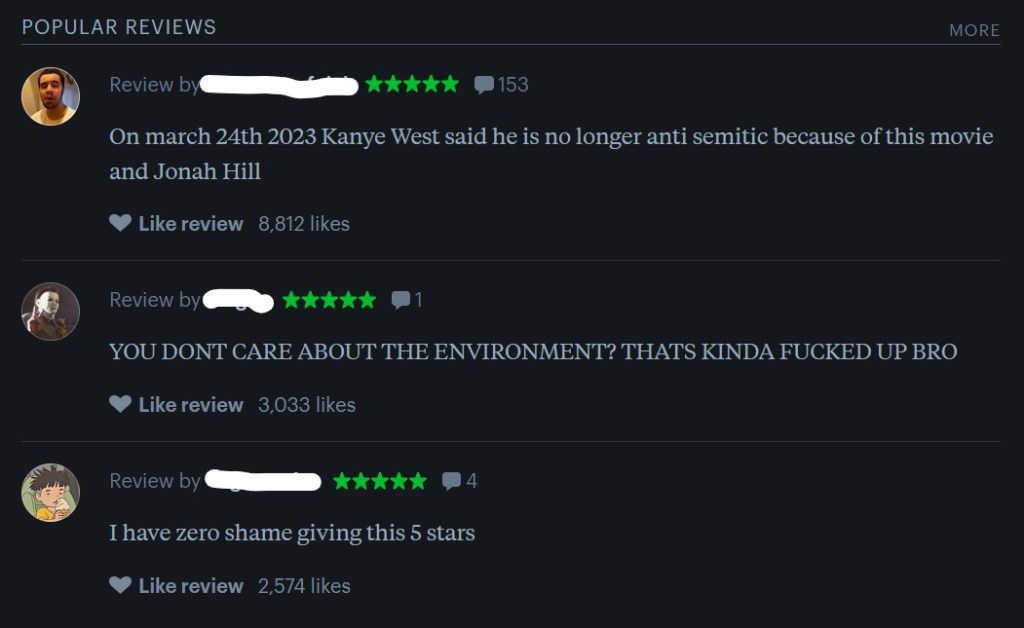
Places like Twitter have embraced the limiting of characters to make an impression; similarly, film-review database Letterboxd thrives on the one-two punch of succinct and sarcastic takes. For example, check out the number of “likes” on these Popular Reviews for 21 Jump Street:
I, too, can be lured by the siren song of simplicity and sarcasm, though I try to maintain a kernel of authenticity.
Heck, I only signed up for Twitter because I thought it would be the ideal venue to start posting brief movie reviews…but that was before I realized, back in 2011, that tweets were limited to 140 characters, not words. (And now I’m stuck with it.)
Maybe it’s the “misfortune” of being born in 1981 and not having social media enter my life until I was in my 20s, therefore making me a dinosaur within its current evolution. I grew up with print media, looking forward to Gene Siskel’s movie reviews in the weekend supplement of our local paper (Ebert’s appeared in the Sunday edition).
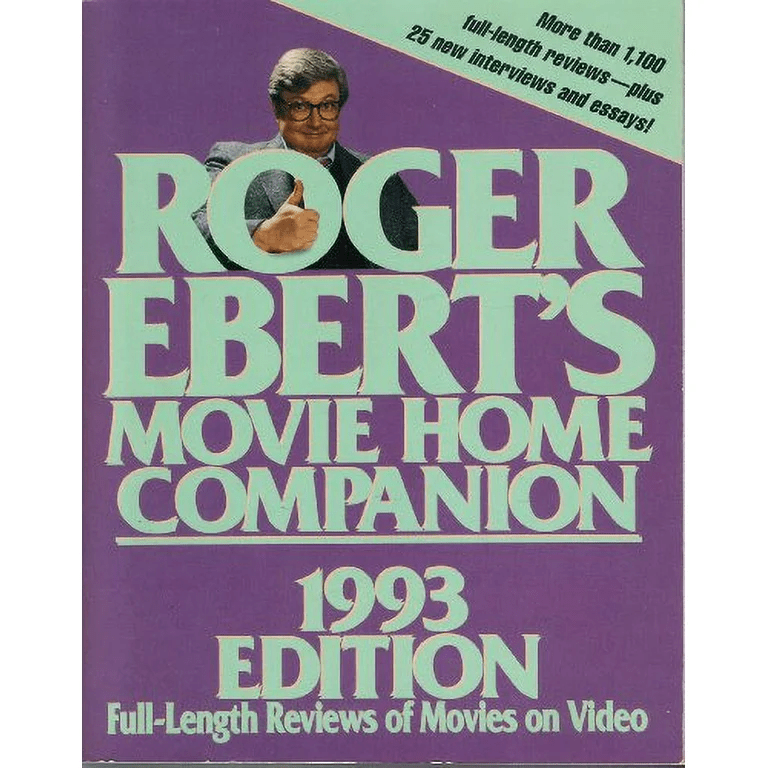
When I was 12, my mother took me to Encore Books (RIP) to purchase Roger Ebert’s Video Home Companion 1993, which I spent untold hours poring over, reading about movies I hadn’t yet had a chance to see, and subconsciously absorbing the art of conveying one’s opinion intelligently through the written word.
I already had a knack for reading and was a particularly good speller; who knows how much additional vocabulary I picked up via this weighty compendium?
I’ve disagreed with Ebert many times over the years, but he taught me a crucial – albeit unspoken – lesson: an opinion doesn’t make someone superior.
Part of Dakota Johnson Syndrome is hiding behind a mask of sarcasm to keep one’s true feelings at bay. After all, true and authentic feelings are left exposed, the potential for them to get ripped apart becomes a terrifying reality.
This ties into the “like”-based nature of social media. The sublimated desire for temporary or permanent online acceptance is very real, with pretenders to the throne emerging daily to pounce on the opportunity (usually by posting the dumbest shit imaginable). The best way to overturn this rock is to assimilate to the unique (anti-)social mores that mark most social-media interactions.
Put simply: be more like Dakota in 21 Jump Street.
Meanwhile, I’ve accepted my lot: when I write a review, I read (and re-read) and second-guess my word choices and grammar until I drive myself crazy before surrendering to what becomes the Final (“good enough, I guess”) Draft.
When writing for someone other than myself, I tend to go long. I would attribute this to my Ebert-based upbringing, but also critics like MaryAnn Johanson, Brian Orndorf, and the staff at Film Freak Central, who were huge inspirations during my early years on the Internet.
More so than expanding my perception of the art of film and opinion, I honed in on these particular writers because, like Ebert, even when I disagreed with them, I could understand their rationales and respect how their methods of expression. Whether they loved or hated something, you felt the passion for the medium driving it.
I started typing up my own reviews when I was 12 (I still have them somewhere, and nobody will ever see them). Years passed, I learned more words (and watched more movies), and things expanded from there.
I don’t know who reads my stuff, but I appreciate whomever does.
But who can tell a paid shill from someone with an authentic take anymore? The line’s not blurred anymore; it’s fucking invisible.
I will admit to a knee-jerk skepticism toward #FilmTwitter folks with tens of thousands of followers. Not that there’s anything wrong with that, but what seems to sneak into these accounts is a superiority complex that tends to treat followers as illiterate peons to be condescended to.
Beware the folks who engagement-farm by using this template:
“If you haven’t seen [name of some dumb movie], then there must be something wrong with you.“
Though maybe this template isn’t even a thing anymore; I haven’t seen it used in a long time. Or perhaps I’ve just done an extremely good job of blocking those who do.
In any case: the engagement just seems to flutter in for these folks, when all I see is someone making pronouncements to the Peasants who are so dumb, they could only in this lifetime wish to acquire the level of knowledge these redundant Superior Gods possess.
Despite how severely I could disagree with him, Ebert was always able to break down his opinion and provide a rationale for his thinking. While his verbal barbs toward Siskel could be funny or cringe (or both), I can’t help but wonder what was left on the cutting-room floor once the segments were edited down to fit a half-hour block.
In the pre-Internet days, looking to TV or newspaper critics for opinions on the latest art was a special event in and of itself. As with the shining stars of Hollywood, it seemed like only a select few were fortunate enough to acquire such a job, let alone make a living off of it.
But that’s all gone now, because nothing and everything is special.
The widespread availability and simplicity of modern technology has created a bottleneck of unfiltered content, to the point where finding a good starting point becomes a Sisyphean task. It was interesting to be alive at a time before the Internet became so heavily commodified (remember when Facebook didn’t have ads poking into your “Wall”? Jonny Numb remembers), before the siren song of inflammatory contrarian idiocy laid waste to intellectual curiosity and left us focused on fleeting notions of “acceptance” at the expense of what’s left of our souls.
Nothing is really “good” or “bad” anymore; everything completely fucking sucks or is the greatest thing ever, with no in-between.

Popularity is contingent on follower count; ergo, follower count dictates just how appealing the masses find your personality/shtick. I guess if you can sustain this balancing act and come out the other end with some semblance of genuine personality intact, you’re winning.
Perhaps charisma and sarcasm, melded with the abbreviated communication techniques introduced by social media, has produced this new prototype of human being – the Gen-Z equivalent of the shock-jock radio DJs or hair-metal goofballs who built up giver-of-no-fucks veneers that simply placed a more palatable Halloween mask on the desire to profit off of knee-jerk rebellion.
“Edgy” is the new “rebellious” (and oh so exhausting).
I don’t know…
I’ve always been behind the curve, focusing on the wrong things at the wrong times, and distributing my attention in ways counterproductive to any creative ventures I could work toward completing.
Because of that, I’ve always courted mild feelings of jealousy toward those more successful or popular than me (though I rarely admit to such feelings, mostly because: what the fuck’s the point?).
But I can’t do anything more than what comes naturally to me, and if that doesn’t jibe with whatever the popular sentiment favors, then what the fuck can I do about it?
Give up (and give in to the Dakota of 21 Jump Street)? Or keep going (like the subtly methodical Dakota of Suspiria)?
I guess Dakota Johnson Syndrome cuts both ways.
 Jonny Numb
Leave a reply to blackcabprod Cancel reply