
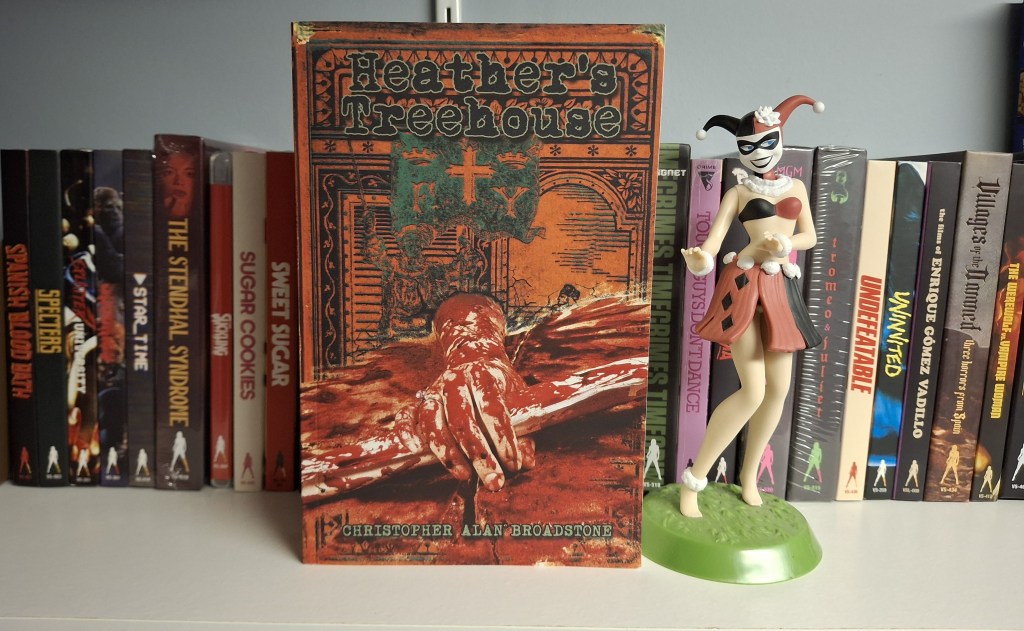
[Author: Christopher Alan Broadstone. Year of Publication: 2025]
When it comes to blowing the literal and figurative doors off a narrative, no author quite wields the detonator with as much agility as Christopher Alan Broadstone. There’s a calculated impishness to the way destruction – of the physical and metaphysical sort – befalls his cast of characters, not unlike the machinations of a 1950s monster movie infused with the gore-infused sensibilities of modern cinema, where the sky’s the limit for creative, special-effects-happy avenues of violence and images of widespread decimation.
In fact, I would argue that the last 100 pages of Heather’s Treehouse are so thoroughly stained with blood, chaos, and enough property damage to keep a county auditor occupied for several lifetimes, it almost threatens to overshadow the plight of its characters. But the action holds together well enough to maintain focus and conclude on a satisfying – and appropriately horror-centric – note. Indeed, it is not until the final pages that we realize Broadstone – juggling myriad plot threads and timelines – was hiding a lot of hints and symbols in plain sight of the ultimate confrontation between Modern Good and Ancient Evil.
Those familiar with Broadstone’s other literary work – particularly the dark fantasy-horror Puzzleman – will instantly recognize the author’s almost academic interest in establishing a context and mythos for his monster: in this case, the titular witch – an aberration of Native American black magic – finds herself at the mercy of a ravenous mob in the 1700s, her spirit eventually confined to a distinctive, clawed black oak in what goes on to become modern-day Edgewood, Texas.
The cheekiness of the locale’s name is not lost on Broadstone, who uses it as a double-edged blade: on one hand, Edgewood becomes indicative of a town that finds itself increasingly in the stranglehold of powers beyond rational logic’s ability to explain; on the other, it doubles as the sharply-rooted “woodworms” Heather uses as a network of splintery, body-impaling tools to rain down destruction on the town (imagine the below-the-surface beasts from Tremors crossed with the climax of Lucky McKee’s The Woods, and you got it).
When things descend into chaos, Broadstone knows how to make it all feel hopeless – humans will sometimes undo themselves before any outside threat has a chance – but also not entirely beyond redemption. While it is rather clear who the last men/women standing will be, their fates are far from telegraphed by the narrative proper – though, like I said, the author sprinkles hints like breadcrumbs on the way to the witch and her (tree)house.
The characters are grounded in a small-town reality that is heightened somewhat by the unconventionality of their names (Matley; Pappy Sobs; Mrs. Gameblossom; Brax; Binge; Ruffis; Serapis; Deputy Earal; the list goes on). I thoroughly appreciated the down-to-earth manner in which Broadstone describes the travails of being a smarter-than-average teenager, monitored intently by bullies harboring deeply-buried insecurities; the banality and bureaucracy of law enforcement, and dealing with the small-town population that feeds into a certain blue-collar stress that only intensifies once the action leaves conventional reality; the arguments of local minds when, faced with the impossible, see it best to debate matters of which religion properly predicted the pestilence on the horizon; and the sage wisdom of an elderly Native American with insight into the legend and curse of Heather.
It is in these passages of world-building and character development that Broadstone’s prose shines most brightly. There’s a palpable rhythm to the interactions and conflicts that keeps the pace moving at a steady – and always interesting – clip. In the novel’s final part – entitled “Day of the Woodworms” – he even defies convention by depicting a previously unrepentant character who, through horrific circumstances, looks inward to discover his destiny within the throes of Heather’s burgeoning gore war.
There is a richness and – most important of all – literacy to Broadstone’s storytelling that never comes across as less than fully realized. While wood is a predominant subject throughout Heather’s Treehouse, there is nothing pulpy or disposable about this intellectually probing stroll through occultism and earth-ravaging vengeance.
(Find Heather’s Treehouse and other works by Christopher Alan Broadstone here: https://www.poetrope.com/Books.html)
 Jonny Numb
Leave a comment