
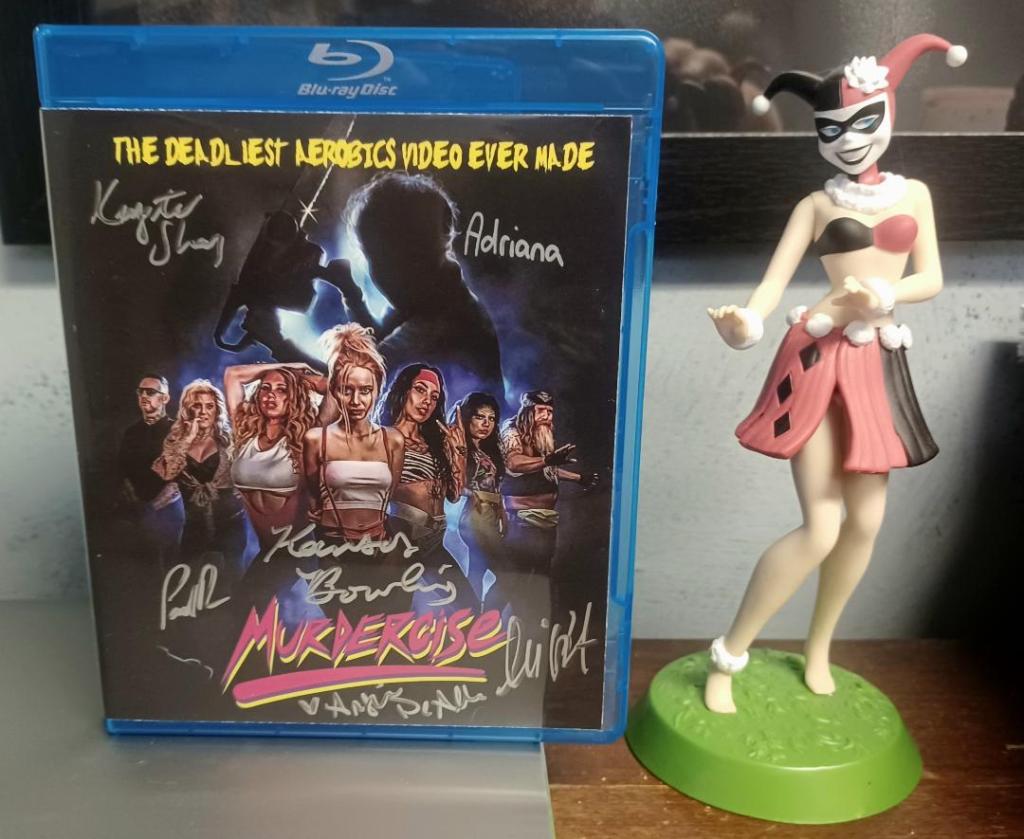
There are a bunch of star-making performances in Murdercise, but Kansas Bowling, um, “bowls” over the competition. Which makes a lot of sense, since the film centers around the cutthroat world of the ‘80s exercise-video craze, with a collection of ladies in workout gear looking to become the cover-model that will greet drooling video-store patrons from coast to coast.
Bowling plays the perfectly-named Phoebe^, a petite, puritanical girl who believes in the positive physical and mental benefits of exercise, to the point where she openly objects to producer Gino’s (Bryan Hurd) and her competitors’ overt sexualization of the filmmaking process. Over the course of Murdercise, she evokes the scream-queen assertiveness of Linnea Quigley in her prime, but also displays the impeccable comic timing of Tina Fey (at times, Murdercise feels like a 30 Rock bit writ large).
And, as she appears spattered in blood in the film’s promotional materials, it goes without saying that Phoebe gets her homicidal groove on.

But Murdercise is a tricky little production that has more on its mind than T&A (which it still delivers) and geysers of gore (which it also delivers).
The husband-and-wife writing-directing team of Paul Ragsdale and Angelica De Alba were also responsible for Streets of Vengeance, an ambitious production that was, at its core, a female-led revenge flick, but also commented on institutionalized misogyny and female empowerment in ways that didn’t play for mere “social conscience” points. For all its violence and discomfort, Streets tapped into an earthbound humanity that allowed its exploitation elements to resonate as something more than base-level shock value.
And Murdercise is no different – in a horror landscape already littered with countless ’80s-fetishizing filmmakers making unmemorable schlock, Ragsdale and De Alba shake up the tone and intention of their work with stunning confidence.
In addition to Phoebe’s objections to all the, um, objectification, director Mikey (Luis Maya) is gay, and crewmember/gofer Chuck (Drew Marvick) – depicted as a bearded, tattooed tough guy – actively refuses the overt advances of busty scream queen Candy (busty scream queen Jessa Flux) out of fear that he won’t be allowed in the union if he gives in to temptation. And Isabella (Nina Lanee Kent), the muscle-car-driving delinquent daughter of mafia momma Dominica Stromboli (Ginger Lynn), is a street-smart, unflappable badass who forges an unlikely alliance with Phoebe.

Character camaraderie goes a long way with me, and the fact that the actors have such chemistry with each other makes the first death hit with a shock that sets the tone for the rest of the film. What starts off as very funny metamorphoses into something a little less funny…until the third act enters a surprisingly dark place (the color palette literally descends into black with pale blue lighting).
Ragsdale and De Alba’s commentary on misogyny and the commodification of sex in American society is as strongly felt here as in Streets, but their delivery system goes from sleazy producer Gino to two characters who exist only in the background of the film until the last act. In doing so, the story takes a sharp right turn into veiled commentary on consent and notions of authority in Reagan’s America.
The fact that this narrative shift comes across so seamlessly speaks to the filmmakers’ talents overall. Something that would be jarring in any other movie instead feels organic, as the characters transition to a level of desperation and threat altogether different than the more tongue-in–um–“cheek” incidents that inform the early going.
3.5 out of 5 stars (but likely to go up on repeat viewings)
^ = “Phoebe” is also a character in Tony Millionaire’s Maakies comic strip: a bourgeois, bespectacled bird who prides herself on propriety and social standing while putting up with the irresponsible/criminal antics of her eternally sloshed suitor, Drinky Crow.

 Jonny Numb
Leave a comment