
I saw Becky at a turbulent, transitional time in my life: in June 2020, the pandemic was still several months fresh, as government officials flailed their arms while doing precious little to assuage the concerns of the public. My partner and I had also been on the receiving end of a bad neighbor situation, which prompted us to get ourselves quickly packed for a move we hadn’t anticipated.
I have no idea how I initially found out about Becky. Maybe the all-mighty Algorithm played a part? That answer is as good as any. Maybe I took notice because I was already a fan of Cary Murnion and Jonathan Millot, the directing team who also made Cooties and Bushwick.
As indoor movie theaters were still shut down, and no drive-in near me was playing it, I paid to stream the movie.
Despite its imperfections, Becky stuck with me in a way few movies do: attribute it to Murnion and Millot’s decision to cast comedic actors (Kevin James, Joel McHale, and Amanda Brugel) in straight dramatic roles; the strange absurdity of its premise (pint-size Lulu Wilson goes ballistic on a gang of neo-Nazis); the electronic pow-wow chant of Nima Fakhara’s brilliant score; and – last but not least – Wilson’s depiction of a 12-year old girl driven to acts of ultraviolence.
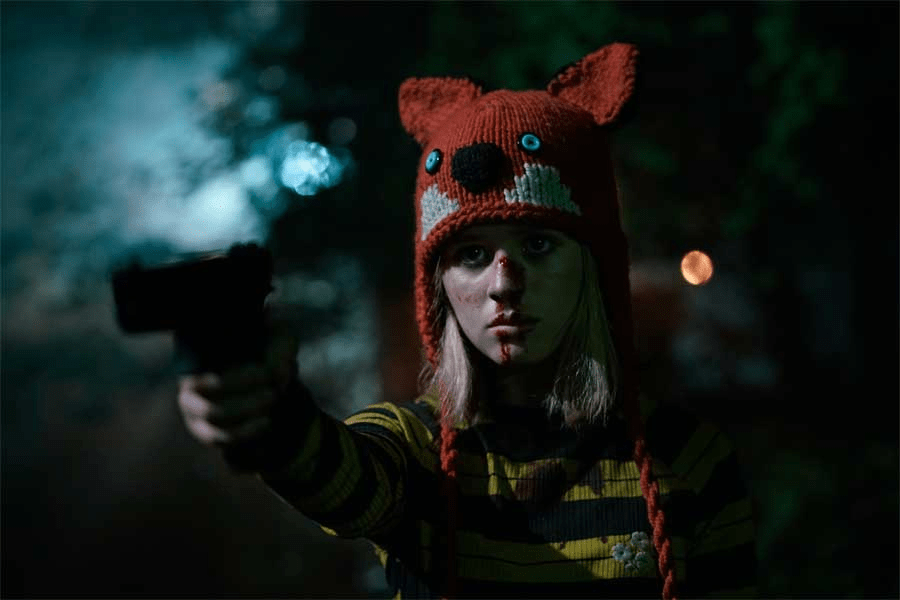
While the villains of the piece were more understated than the white supremacists of, say, American History X, Becky was not aiming to provide sparkling social commentary. Case in point: at least two of the neo-Nazis in this pulpy fable were herd-following idiots who had no idea what they really signed up for. That said, there was no small significance to the depiction of men hiding inside a pack mentality, only for their façade to fall away once faced with Wilson’s unstoppable force of nature.
I always thought Becky would pair well as the wicked stepsister to Oz Perkins’ brilliant Gretel & Hansel, which came out earlier that same year. Both films depict young women on the cusp of adolescence, forced into harsh, unforgiving worlds where they are their only defense against the forces of fate and mortality.

Becky ended on a cliffhanger that promised more bloody adventures on the horizon. I became so smitten with the idea that I typed up the first act of a sequel (that I subsequently set aside when I caught wind of The Wrath of Becky).
There’s a certain catharsis to watching Wilson go full-on savage against home invaders, and it’s easy to get in her corner as she slays them in the most gruesome, over-the-top ways possible. The notion of more of this – not unlike the promise of more Death Wish or John Wick sequels – filled me with giddy delight.
2020 was a rough year for all of us, and I’ve documented my own struggles (namely, the loss of my father right before the pandemic) elsewhere. Maybe that’s another part of why Becky refused to leave my consciousness. If Gretel & Hansel represented a melancholy approach to coming of age, Becky lashed out at the world with teeth and claws bared.

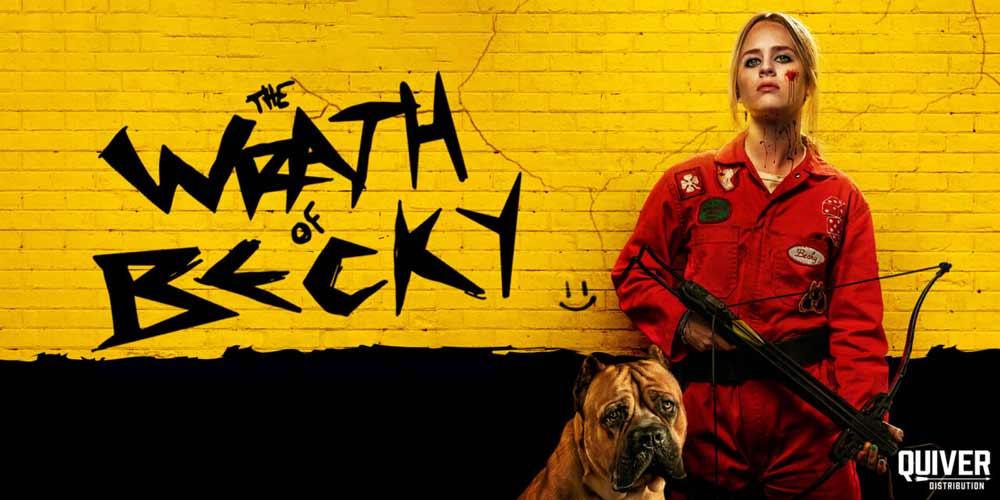
In The Wrath of Becky, our heroine is now 16, escaping foster homes in hopes of finding her true place in the world. She still has her loyal pooch Diego (Pac Williams) and gets an internal monologue to amplify her thoughts (which are, unsurprisingly, full of teenage snark). She finds a stable home with kindred spirit Elena (Denise Burse), who subtly alludes to the traumas and familial losses that informed her youth. In a nice bit of character shading, she makes Becky participate in her breakfast-time ritual of naming things she is grateful for.
Meanwhile, the Noble Men – a Proud Boys-styled group of misogynist white supremacists – are passing through on the way to protest a political rally for Senator Hernandez (Gabriella Piazza). Running afoul of Becky at a diner, they set their sights on “scaring” what they view as a negligible threat. The Noble Men’s actions and words crudely undermine the fairer sex; therefore, a teenage girl is not only a lesser threat, but fair game in a worldview where “pick on someone your own size” holds no meaning.
With the conflict established, The Wrath of Becky chugs along in a regimented manner for 84 extremely efficient minutes. Co-writers and -directors Suzanne Coote and Matt Angel (who also appears as one of the Noble Men) structure the things in an interesting way – instead of being a mindless retread of its predecessor, the film fluctuates between passages of character interaction offset by the ultraviolence fans of the character expect. It maintains certain stylistic tics originated in the 2020 film (including an animated opening-credits sequence), but also shows the evolution of Becky and her ethos – while prone to outbursts of deadly rage, her mission here is as informed by emotion as it is by the positioning of her adversaries as dangerous, hate-spewing scum.

That said, Coote and Angel don’t follow the Death Wish sequel route of making their hero bulletproof; nor do they make the villains one-dimensional monsters for the sake of easy catharsis. Wilson is given a variety of emotions to explore, and skillfully fluctuates between mournfulness, vulnerability, anger, and twisted amusement with grace and ease.
The villains are given their own individual personae: Anthony (Michael Siroe) is the muscular would-be alpha of the group; DJ (Aaron Dalla Villa) is a chuckling youngster who views the Noble Men as the actualization of some action-movie fantasy; Sean (Matt Angel) is the Doubting Thomas; and Twig (Courtney Gains) is the classic shit-for-brains, redneck-in-overalls archetype who shoots first and asks questions later. Seann William Scott (as ringleader Darryl) proves an effective dramatic presence here, showing genuine range as his performance goes from a sense of authority and control to an unraveling panic of desperation, madness, and violence.
I guess what I’m saying is, if Becky becomes an ongoing series, I have no problem whatsoever with Wilson becoming a Paul Kersey or John Wick for the 2020s and beyond. The ending teases more Brotherhood mythology and presents a character turn that can only lead down more interesting avenues (politically and otherwise).
3.5 out of 5 stars
(The Wrath of Becky is currently available to rent or purchase via the digital retailer of your choice. A U.S. DVD release is scheduled for August 8.)
 Jonny Numb
Leave a comment